
Madhuka De Silva
Co-designing Inclusive Movement Learning Tools with Blind and Low Vision Users
PhD Research funded by and conducted at Monash University, Australia

Image generated through Wix AI
Awards
Awarded third place in Tactile and Embodied Design Competition, International competition organised by Georgia Tech University, 2024
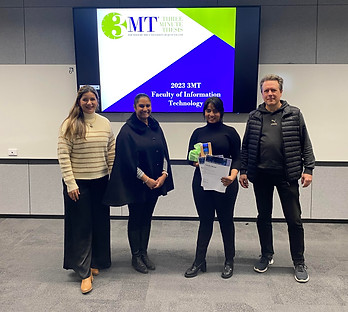
Winner in thesis in 3 minutes competition
Context
People who are blind or have low vision (BLV) face significant barriers to participating in recreational movement activities like dance and fitness.
A key reason is that most teaching methods rely heavily on visual demonstration or vague verbal cues, with limited adaptation for non-visual learners. Physical guidance is sometimes used, but it can be inconsistent or uncomfortable.
Problem
How can we design accessible, non-visual approaches that support both BLV learners and their teachers in body movement education?
Solution
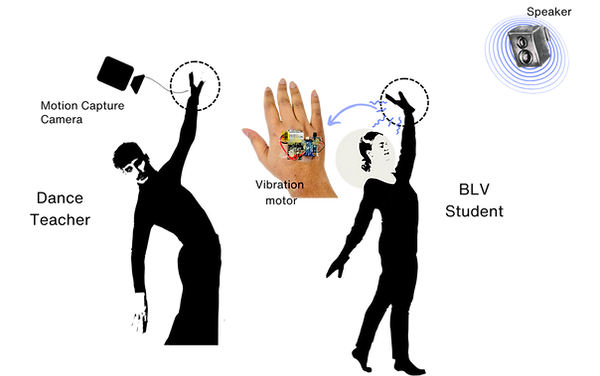
Providing sound and haptic feedback to student compared to teacher’s movement to provide precise details. Body movement is tracked through motion capture camera.
Research Skills and Methods
Designing Solutions Grounded in Context,
-
Identified gaps in research and real-world teaching practices
-
Centred lived experiences of BLV people as design drivers
-
Co-designed with BLV learners, teachers, technical experts, and accessibility researchers
Understanding User Needs through Mixed Methods,
-
Designed and analysed 2 surveys for both qualitative and quantitative insights
-
Conducted 39 semi-structured interviews with deep, active listening
-
Facilitated 4 focus groups to uncover shared priorities and challenges
-
Ran 11 in-situ workshops to observe real-world behaviours and understand needs
-
Applied reflexive thinking and both inductive and deductive analysis methods
What I delivered and Impact
-
Identified 4 key design challenges in accessible movement education by working closely with BLV learners and their teachers
-
Developed practical design guidelines for creating mult-isensory tools, including 5 main and 14 supporting considerations
-
Created a novel multi-sensory prototype that uses sound and vibration to support dance learning for BLV learners
-
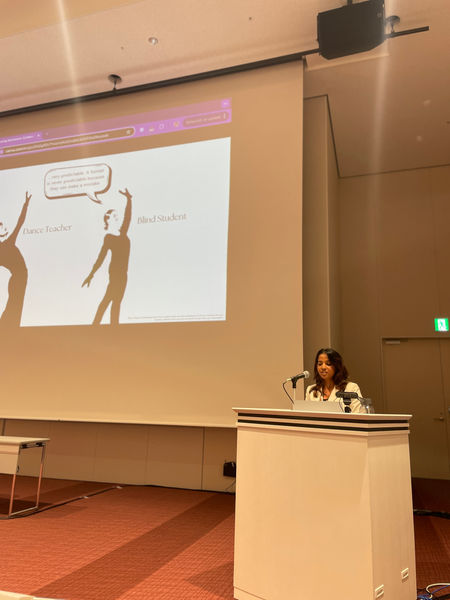
Published findings through (peer-reviewed) high impact international conferences
-
ASSETS 2023 (NY, USA): Understanding needs of BLV learners and teachers
-
CHI 2025 (Yokohama, Japan): Exploring ideas through bodystorming workshops
-
ASSETS 2025 (Colorado, USA): Co-designing to support accessible dance learning
-
-
Communicated through radio interviews with Vision Australia
Leading and Learning Through Mentorship
Guiding the Next Generation Towards Inclusive Design
-
Supervised six undergraduate students working on accessible online dance learning for BLV people
-
Extended an opportunity from my PhD into a student-led, real-world research project
-
Guided projects focused on movement tracking, sound feedback, and accessible web interfaces
-
Encouraged inclusive thinking and practical problem-solving in accessibility
